
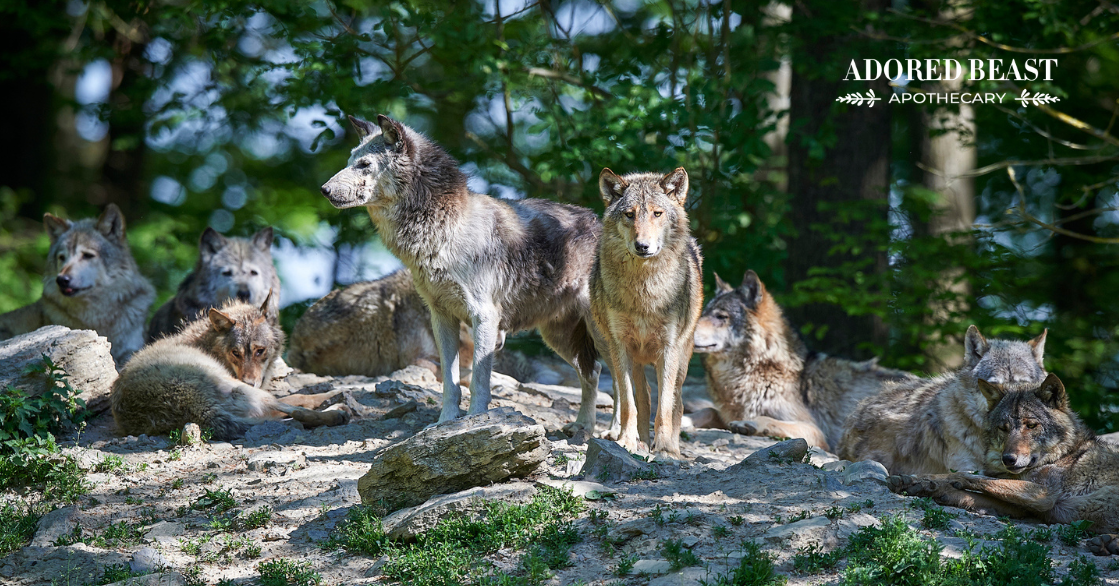
When we first got our husky Inuk, way back in 2008, they weren’t a super popular breed. You didn’t see a lot of them around, and often when people saw us walking, they’d make a comment about her being part wolf. Some were even nervous of her. At the time, we thought it was funny. Inuk was the sweetest, gentlest dog, silly and goofy – so the fear always made us laugh.
But, according to new research, that fear is fact-based. Are dogs part wolf, even today? Yes! Most modern dogs (from huskies to chihuahuas) still carry DNA from wolves!
Are Dogs Part Wolf? The Study
We know from past research that the split between our domestic dogs and wolves happened about 20,000 years ago. The common ancestor was a now-extinct type of gray wolf. And although dogs and wolves have continued to live in largely the same habitats (modern homes excepted, of course), and can technically breed together, there’s little evidence to suggest that they do so (or have done so) on a regular basis.
Still, scientists were interested to see how “big” a split there actually was. Their goal? determine if our modern dogs still carry some of that ancestral DNA even thousands of years after dogs were domesticated.
In this new research, scientists re-examined the DNA from 2,693 dogs and wolves, including “breed” dogs, village (or stray) dogs, and wolves – some going back many generations.
What they discovered: many dogs still have wolf DNA!
- A big surprise: they found that about 64% of modern breed dogs carry detectable wolf ancestry.
- Even more striking: every single village dog they tested – free-roaming dogs living around humans – had some wolf DNA.
- The amount of wolf DNA is usually small – often only a fraction of a percent of the dog’s genome.
[RELATED] Gut Bacteria from Wolves May be Key to Canine Health: New Study
Does the Breed Matter?
Ok, you might be thinking, sure, for some breeds (the wolf-like husky, for example), this makes sense, but surely not all breeds:
- As expected, breeds that were deliberately bred from wolf-dog hybrids (for example, certain “wolfdog” breeds) had high wolf ancestry – between 23% and 40%.
- Among more typical dog breeds, some had more wolf DNA than others. For example:
- One breed had as much as 4.7–5.7% wolf ancestry.
- Other breeds, including small dogs like chihuahuas, still carry some (though little) wolf DNA (~0.2%).
- Broadly, larger dogs or those bred for tasks like hunting, herding, or sled work tended to show more wolf DNA.
- Breeds that are small, or bred for companionship, generally showed less, but trace remains were common.
So, interestingly, most dogs – big and small, working and lap – still carry some wolf DNA.
How Wolf DNA Might Influence Dogs Today
When we introduced The Wolf pre and probiotic, we knew that nurturing and acknowledging this link between our canine companions and their lupine ancestors was great for their health. It helped introduce our domesticated dogs to friendly bacteria from wolves, giving them access to beneficial microbes they can’t get anywhere else – ones we know are helping build even stronger bodies!
And this study shows that a little wolf DNA can be really great for dogs in a variety of ways. For “village dogs” (free-roaming, non-bred dogs), the study found wolf DNA especially enriched in olfactory receptor genes – those are the genes that help sense smells. That might have helped these dogs survive by sniffing out food or danger. And, it suggests that interbreeding with wolves long ago helped shape some important traits in today’s dogs, possibly giving them useful survival tools. These ancient wolf genes may have helped dogs adapt, for example, to find food, survive in different environments, or do jobs like herding or hunting.
Does it prevent them from being dogs? No, no worries there. The study shows that dog DNA can keep some wolf DNA while still being domesticated dogs. In fact, some of those traits we’ve come to love in our adored canine companions exist thanks to this wolfy link!
So, are dogs part wolf, really? Science says yes! Our pets today may be more closely connected to their wolfy ancestors than many of us realize. Maybe those people who were a wee bit nervous of Inuk were on to something…
As with anything in life, the idea that dogs and wolves have stayed completely separate since domestication might be too simple. The truth is far more complicated, and hopefully, it gives us new insight into why our dogs may act the way they do, and a new appreciation for those majestic creatures we hear howling in the woods at night. And really, it’s just too cool not to talk about!