Discover the benefits of Turkey Tail mushrooms for dogs and cats, backed by scientific research. Learn how this powerful medicinal mushroom may support immune balance, gut health, antioxidant protection, and overall wellness. Explore promising research on Turkey Tail for canine cancer support, its potential benefits for skin health, and how to choose the right mushroom extract for your pet.
The short version
Turkey tail (Trametes versicolor, also called Coriolus versicolor) is one of the most researched medicinal mushrooms in the world, and one of the few studied in dogs. For dogs and cats, it offers four main benefits:
- Cancer support. Its compound PSP was studied by Penn Vet in dogs with hemangiosarcoma, and a turkey tail extract (PSK) has been used alongside cancer treatment in Japan since the 1980s.
- Antioxidant protection, with more than 35 phenolic compounds.
- Immune modulation, helping the immune system find balance rather than just “boosting” it.
- Gut health, acting as a prebiotic that feeds beneficial bacteria.
It may also help reduce staph bacteria on the skin, which makes it helpful for allergic, itchy dogs.
Is it safe? Turkey tail is very well tolerated by most dogs and cats and is meant for long-term use. It is also lower in oxalates than chaga, so it is the mushroom we suggest for pets with kidney or stone concerns.
What are turkey tail mushrooms?
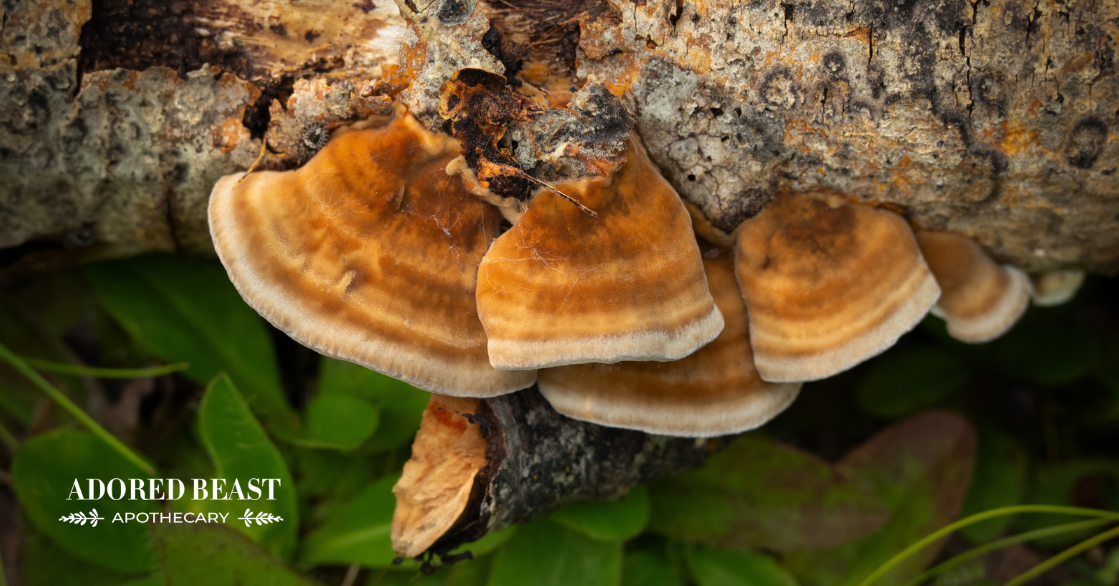
Turkey tail is a bracket fungus that grows around the world on fallen logs and stumps. Its colourful, fan-shaped layers look just like a turkey’s tail, which is where the name comes from. It has no stem, growing out from the wood in wave-like rings.
But we don’t love it for its looks. Medicinal mushrooms have been used for thousands of years, and turkey tail has been a staple of Traditional Chinese Medicine, where it is called Yun Zhi. Decades of research, and a growing body of peer-reviewed studies, now back up much of that traditional wisdom.
What are the benefits of turkey tail for dogs and cats?
Turkey tail is rich in antioxidants, polyphenols, triterpenes, beta-glucans and prebiotics. Here is what the research tells us.
1. Does turkey tail help dogs with cancer?
With so many of our animals receiving cancer diagnoses, this is arguably the most important benefit.
Turkey tail contains two key cancer-fighting polysaccharides:
- PSK (polysaccharide-K) stimulates the immune system to help inhibit several cancer-triggering mechanisms in the body. PSK has been used alongside conventional cancer treatment in Japan since the 1980s.
- PSP (polysaccharide peptide) stimulates the immune system to target and attack tumour cells.
The Penn Vet study. In a 2012 pilot study at the University of Pennsylvania School of Veterinary Medicine, 15 dogs with hemangiosarcoma, an aggressive cancer of the blood vessels, were given PSP after surgery. Dogs on the highest dose had a median survival of 199 days. Before the study, the longest reported median survival for dogs with this cancer who had no further treatment after surgery was 86 days. Some dogs lived more than a year on the mushroom compound alone.
It was a small study, and turkey tail is not a cure. But it is one of the few mushroom studies done in dogs, and it is why turkey tail is now one of the most commonly recommended supplements in integrative cancer care. Always use it alongside your veterinarian’s treatment plan.
Turkey tail’s triterpenes have also shown chemopreventive and chemotherapeutic properties, and human research has looked at turkey tail alongside treatment for:
Facing a diagnosis? Read Facing Cancer in Our Pets: A Guide and Oxytocin and Coping with Canine Cancer: The Love Link.
2. Is turkey tail an antioxidant?
Yes, a rich one. Every day our pets meet free radicals, from normal metabolism and aging to X-rays, pollution, chemicals, stress, processed food and medication. Left unchecked, free radicals cause oxidative stress, which speeds aging and contributes to many health conditions.
Antioxidants neutralize free radicals by donating an electron. Research found more than 35 different phenolic compounds in turkey tail extract, along with flavonoids.
3. How does turkey tail support the immune system?
Turkey tail is a potent immune modulator. That means it can support or calm the immune system depending on what the body needs. It is about bringing the different immune cells back into balance, not simply turning everything up.
This matters. If your dog has an infection, supporting immunity helps fight it off. But if your dog has an overactive immune response, like allergies or autoimmune conditions, you want to calm and balance it. Research shows turkey tail helps regulate immunity, maintain balance and restore healthy immune function.
4. Is turkey tail good for gut health?
Yes. Turkey tail is a prebiotic, meaning it feeds the beneficial bacteria in your animal’s gut. Without food, those good bacteria die off. And since most of the immune system lives in the gut, a healthy microbiome is one of the best defences your pet has.
If you know our founder Julie, you know she is all about the gut. Turkey tail is firmly on her list.
5. Can turkey tail help itchy, allergic dogs?
It may. Turkey tail may help reduce Staphylococcus bacteria, the cause of most staph skin infections. Many allergic dogs end up on antibiotics, not for the allergy but for the secondary skin infection. For dogs and cats with itchy skin or hot spots, turkey tail may help soothe the skin and help prevent infection.
Is turkey tail safe for dogs and cats?
Turkey tail is very well tolerated by most dogs and cats and is designed for long-term use. A few notes:
- Lower in oxalates. Unlike chaga, turkey tail is a good choice for pets with kidney disease or a history of stones.
- During cancer treatment, check in with your veterinary oncologist so everyone is working from the same plan.
- Wild mushrooms are different. Never let your dog graze on mushrooms outdoors. Some are deadly.
Turkey tail powder vs liquid extract: which is better?
This is important. Many companies make good mushroom products, but many are powders, and the way a mushroom is processed changes what the body can use.
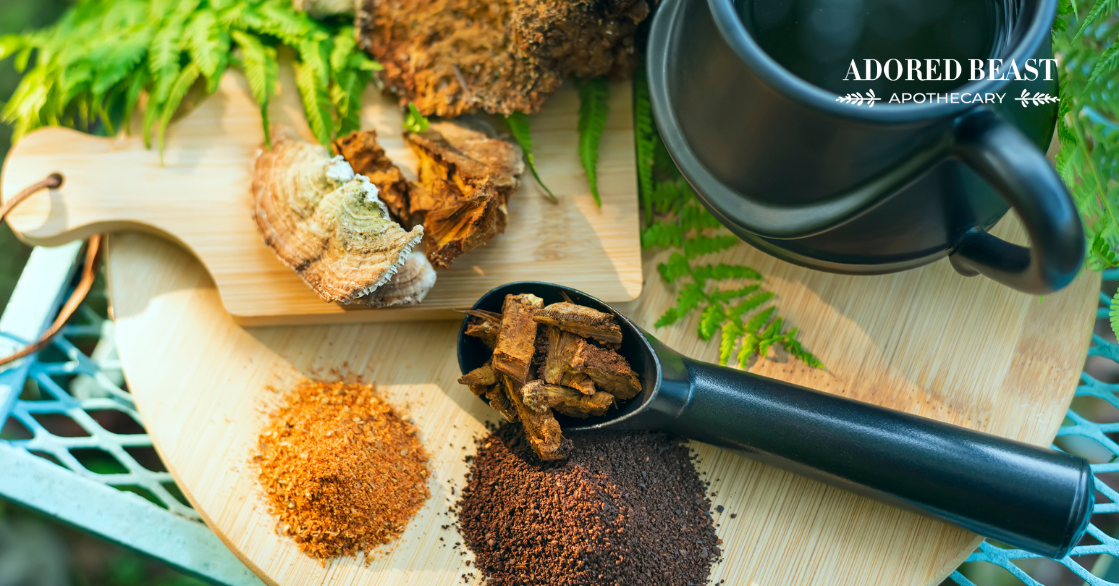
A liquid extract made with hot water and alcohol contains the full spectrum of compounds: water-soluble polysaccharides (like PSK and PSP) and alcohol-soluble triterpenes. Since that full range is where the benefits come from, look for a triple (or at least dual) extract.
Also check what the product is made from. Many products use mycelium grown on grain, which can be mostly starch. Read Does it Really Matter How Mushrooms for Pets are Grown?
Our Turkey Tail Liquid Extract is made from wildcrafted turkey tail grown in North America and harvested using ethical practices that give back to nature. Our mushroom extracts are made with a three-step triple extraction: first hot water (to draw out the beta-glucans and other polysaccharides), then organic alcohol (the only way to extract the triterpenes), then glycerin. Once the process is complete, there is 0% alcohol left, and every batch is tested to confirm it. For horses, we make an Equine Turkey Tail Liquid Extract. Read more in Turkey Tail for Horses.
Should you rotate turkey tail with other mushrooms?
We recommend it. Turkey tail and chaga each bring different strengths, and rotating them month to month gives your pet both. See Chaga vs Turkey Tail: Is One Better Than the Other? and Medicinal Mushrooms for Dogs: The Power of Rotation.
The bottom line
Turkey tail is one of the best-researched, gentlest tools we have for dogs and cats. It supports the immune system, the gut and the skin, provides rich antioxidant protection, and has real research behind it in canine cancer. Whether you are focused on prevention or supporting an existing condition, a quality liquid extract can make a meaningful difference now and in the years ahead.
Frequently asked questions
Turkey tail supports immune balance, gut health and antioxidant protection. Its compound PSP has been studied in dogs with hemangiosarcoma, and it may help reduce staph bacteria on the skin.
A 2012 Penn Vet pilot study of 15 dogs found those given the highest dose of turkey tail’s PSP compound had a median survival of 199 days, compared with a previously reported 86 days without further treatment. Use it alongside your vet’s plan.
Yes. Turkey tail is well tolerated by most cats and is lower in oxalates than chaga, making it a good choice for cats with urinary or kidney concerns.
Turkey tail is meant for long-term use. Many pet parents rotate it month to month with chaga.
Neither is better overall. Turkey tail leads for immune and cancer support; chaga leads for antioxidants and stress. Turkey tail is the safer choice for pets with kidney concerns.
A liquid extract. A triple extract (hot water, alcohol, then glycerin) captures both the polysaccharides and triterpenes. Many powders do not.
Written by The Adored Beast Team at [Adored Beast Apothecary], founded by Julie Anne Lee, DCH, RCSHom, one of the longest-practicing holistic animal health practitioners in North America. [Read Julie’s full bio]
This article is for informational purposes and is not a substitute for veterinary advice. If you are worried about your animal, please contact your veterinarian.